What Vashya Koota indicates
It offers a traditional perspective on mutual attraction, influence, cooperation, and power dynamics between prospective partners.
Vedic Astrology · Marriage and Relationships
Vashya Koota studies the natural interaction between two Moon signs, offering a traditional perspective on attraction, mutual influence, cooperation, decision-making, and power balance.
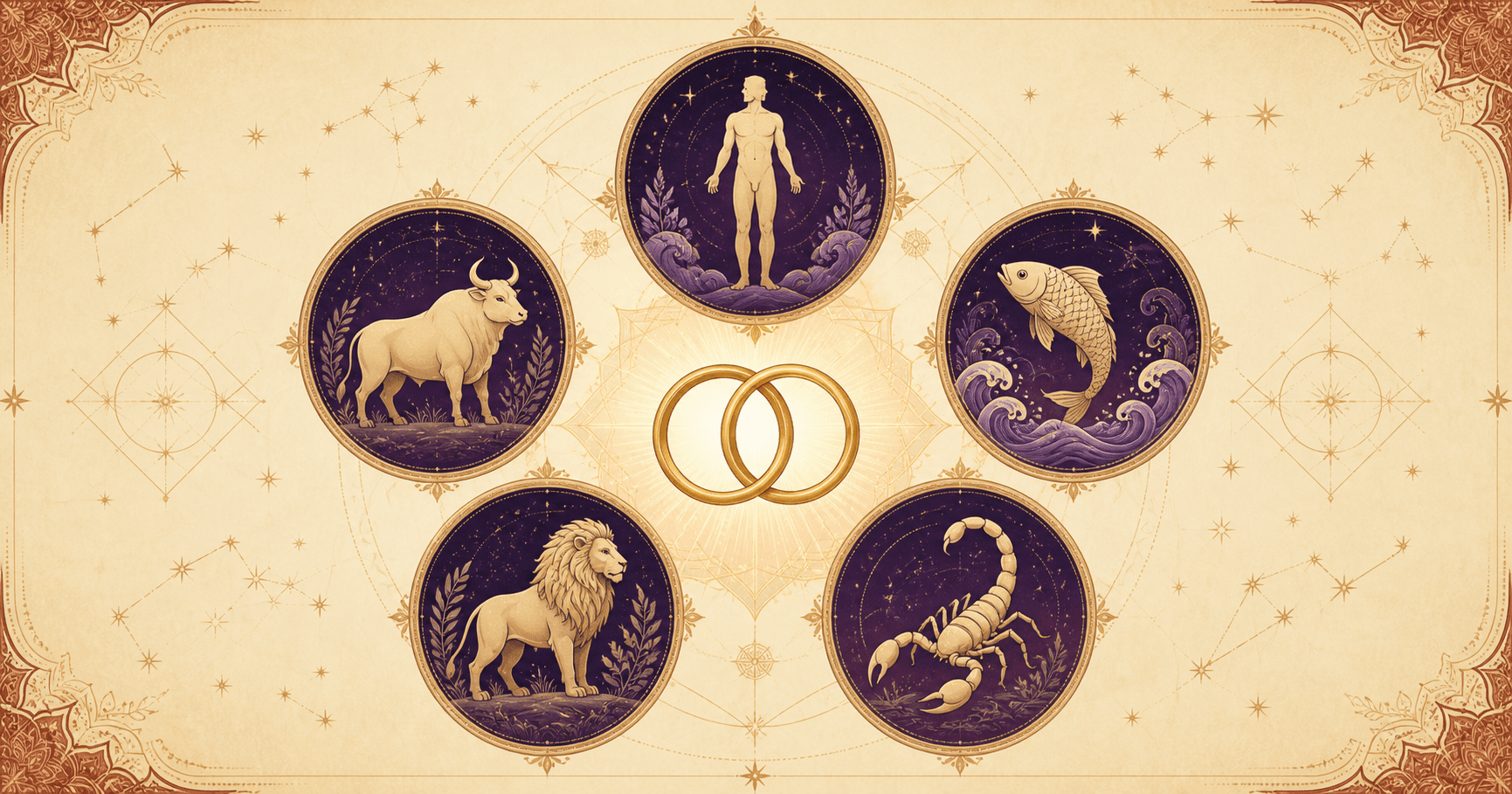
What Vashya Koota indicates
It offers a traditional perspective on mutual attraction, influence, cooperation, and power dynamics between prospective partners.
How it is calculated
The Moon signs of both individuals are classified into one of five Vashya groups and then compared.
Why complete matching matters
Vashya Koota contributes only two points out of 36 and cannot determine marriage compatibility on its own.
Key takeaway
Vashya Koota examines how two people may influence, respond to, and cooperate with each other. A high score is traditionally favourable, but a low score does not prove a relationship will be controlling, conflict-ridden, or unsuccessful.
Vashya Koota—also written as Vasya Koota—is the second factor in Ashtakoota matching. The Sanskrit term is commonly associated with influence, attraction, or the ability to bring something under control.
Older interpretations sometimes asked which partner would dominate. That framing requires care: a healthy modern relationship should not be based on one partner controlling the other.
Vashya Koota is better understood as an indicator of:
The calculation is based primarily on each person's Janma Rashi or Moon sign.
The Ashtakoota system compares eight compatibility factors and awards a maximum of 36 points.
| Koota | Main area traditionally studied | Points |
|---|---|---|
| Varna | Values and spiritual temperament | 1 |
| Vashya | Attraction and mutual influence | 2 |
| Tara | Birth-star harmony | 3 |
| Yoni | Instinctive and physical compatibility | 4 |
| Graha Maitri | Mental compatibility and friendship | 5 |
| Gana | Nature and temperament | 6 |
| Bhakoota | Emotional and family-related harmony | 7 |
| Nadi | Constitution and traditional health considerations | 8 |
| Total | 36 |
Vashya Koota carries only two points. It is relevant, but not powerful enough to decide the suitability of a marriage independently.
Partners affect each other's decisions, emotions, and behaviour. Vashya asks whether that influence may feel cooperative or difficult to balance.
It may highlight differences in initiative, independence, or authority before they become recurring disagreements.
A supportive combination may indicate responsiveness with fewer instinctive conflicts; a lower score may require more conscious effort.
This differs from Yoni Koota, which is more directly associated with instinctive and physical compatibility.
Vashya can begin a conversation about equality, boundaries, and shared responsibility, but it cannot diagnose controlling behaviour.
Some signs are divided according to the Moon's degree, so knowing only the sign name may not always be enough.
Each classification symbolically describes movement, instinct, and interaction.
Aries · Taurus · Second half of Sagittarius · First half of Capricorn
This group is traditionally connected with determination, physical energy, practical action, persistence, stability, strong preferences, and resistance to pressure. People in it may be dependable and focused but may need time before changing an established opinion.
Gemini · Virgo · Libra · Aquarius · First half of Sagittarius
Nara is associated with intelligence, communication, social awareness, practical reasoning, adaptability, negotiation, and interest in ideas. People in this group may prefer discussing problems and finding workable solutions.
Cancer · Pisces · Second half of Capricorn
Traditional qualities include emotional sensitivity, intuition, adaptability, empathy, receptiveness, imagination, and a need for emotional security. This group may respond strongly to a relationship's emotional atmosphere.
Leo
Vanachara is associated with confidence, leadership, pride, independence, courage, protectiveness, and strong self-expression. It should not be interpreted as aggressive or incompatible by default; it symbolises a powerful, self-directed nature.
Scorpio
Keeta symbolism includes intensity, privacy, determination, emotional depth, strategic thinking, strong boundaries, and transformative experiences. This does not mean every Scorpio behaves in the same way; the complete chart remains necessary.
| Bride's Vashya | Chatushpada | Nara | Jalchar | Vanachara | Keeta |
|---|---|---|---|---|---|
| Chatushpada | 2 | 1 | 1 | 1.5 | 1 |
| Nara | 1 | 2 | 1.5 | 0 | 1 |
| Jalchar | 1 | 1.5 | 2 | 1 | 1 |
| Vanachara | 0 | 0 | 0 | 2 | 0 |
| Keeta | 1 | 1 | 1 | 0 | 2 |
Tables can vary slightly by regional convention or software. The same recognised system should be used throughout an analysis.
Maximum score, usually awarded to the same category; traditionally strong mutual responsiveness
Supportive interaction styles that may complement one another
Moderate compatibility with manageable differences
Contrasting styles, sometimes called Vashya Dosha, requiring closer analysis
Zero does not prove domination, frequent arguments, or an unsuccessful marriage.
Vashya Dosha is a term sometimes used for a low or zero score. It may traditionally point to differences in decision-making, resistance to influence, a strong need for independence, unequal expectations, difficulty compromising, power struggles, or contrasting communication styles.
A mismatch is not a diagnosis of an unhealthy relationship. Actual controlling behaviour must be assessed from real actions, not from an astrology score.
Some astrologers consider a low score less concerning when other supportive combinations are present:
Balancing rules differ across traditions. Both charts should be examined before reaching a conclusion.
Yes. A zero score alone should not approve or reject a marriage. Vashya contributes only two points; the total score, mental and emotional compatibility, temperament, physical compatibility, Manglik Dosha, Bhakoota, Nadi, the seventh house, Navamsa, Dashas, and real-life expectations all matter.
The couple's ability to communicate, respect boundaries, and make decisions fairly matters more than any single score.
Vashya studies influence and responsiveness through Moon-sign groups and carries two points. Graha Maitri studies mental friendship through the Moon-sign lords and carries five points.
Vashya has five Moon-sign classifications and concerns cooperation. Yoni has 14 Nakshatra-based animal classifications and concerns instinctive and physical compatibility.
Read the Yoni Koota guideNo responsible modern interpretation should use it to justify control. The focus should be mutual influence rather than control, cooperation rather than obedience, shared decisions rather than domination, healthy boundaries rather than submission, and respect for both partners' independence.
Astrology should help people understand relationship patterns, not justify coercion or unequal treatment.
Any astrological remedy should be based on both complete charts. A generic gemstone or expensive ritual should not be prescribed solely from the Vashya score.
Why the complete Kundli matters
Complete matching explores emotional understanding, mental compatibility, temperament, physical attraction, communication, family patterns, Doshas, stability, Navamsa indications, and current or upcoming planetary periods.
Vashya Koota should never justify one spouse controlling the other. Its two points are only one small part of a responsible analysis.
Understand your compatibility beyond the Guna score
The Vedic Report Marriage Matching Report studies both charts to explain emotional, mental, and practical compatibility, major Doshas, planetary influences, and areas that may require adjustment.
Get My Marriage Matching ReportDetailed PDF analysis · Based on both birth charts · Delivered via email or WhatsApp within 24–24–48 hours
Vashya Koota is the second factor in Ashtakoota matching. It traditionally examines attraction, mutual influence, cooperation, and power dynamics between prospective partners.
Both spellings are commonly used in English. “Vashya Koota” is closer to the Sanskrit transliteration, while “Vasya Koota” is also widely searched and understood.
It carries a maximum of two points out of the complete 36-point Ashtakoota system.
Vashya is primarily determined from the Moon sign. Sagittarius and Capricorn are divided into two categories according to the Moon's degree.
The five classifications are Chatushpada, Nara, Jalchar, Vanachara, and Keeta.
Aries, Taurus, the second half of Sagittarius, and the first half of Capricorn are generally classified as Chatushpada.
Gemini, Virgo, Libra, Aquarius, and the first half of Sagittarius belong to Nara Vashya.
Two is the highest Vashya Koota score and traditionally indicates supportive compatibility in mutual influence and cooperation.
Zero indicates a traditional mismatch, sometimes called Vashya Dosha. It may highlight differences in influence or adjustment, but it does not predict relationship failure.
Yes. The score should be considered with the other seven Kootas, complete birth charts, Navamsa, and real-life compatibility.
Some traditions consider it reduced when the Moon-sign lords are the same or friendly, or when other marriage indicators are strongly supportive.
Older interpretations sometimes describe it that way. A modern, responsible interpretation focuses on mutual influence, cooperation, equality, and decision-making rather than control.
Not necessarily. Remedies should be considered only after both complete charts are analysed. Communication and healthy relationship practices remain essential.
No. It is only one factor worth two points. A successful marriage also depends on emotional maturity, communication, respect, shared values, and personal choice.
Vedic Report Editorial | September 2026
This article is provided for educational and general informational purposes based on traditional Vedic astrology principles. Astrological compatibility does not guarantee a particular relationship outcome and should not be the sole basis for marriage or another major personal decision.