What Yoni Koota indicates
It is traditionally used to understand instinctive attraction, physical compatibility, and intimate comfort between two people.
Vedic Astrology · Marriage and Relationships
Yoni Koota is one of the eight factors in traditional Ashtakoota matching. It studies instinctive attraction, physical compatibility, intimacy, and the natural comfort shared between two partners.
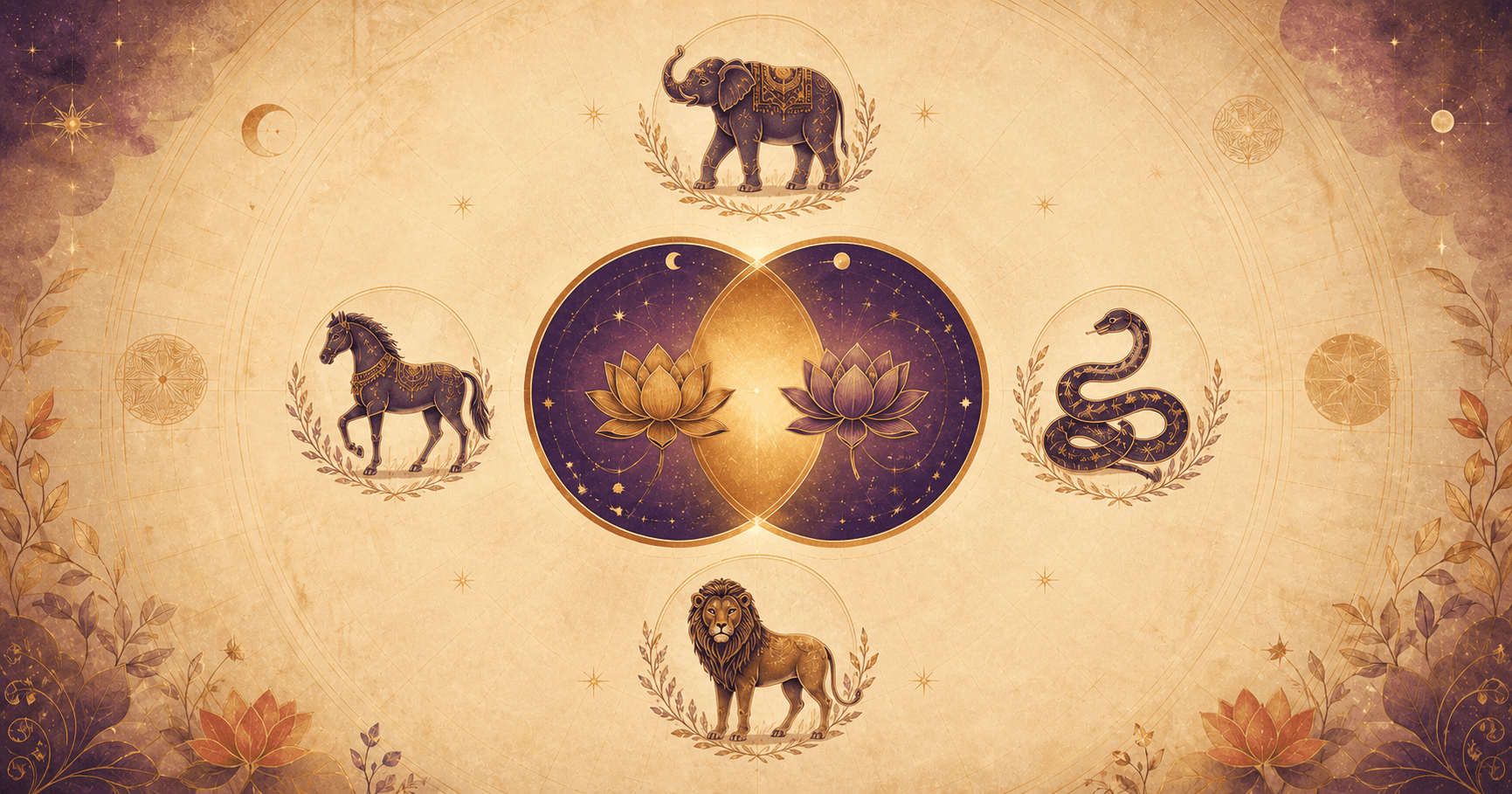
What Yoni Koota indicates
It is traditionally used to understand instinctive attraction, physical compatibility, and intimate comfort between two people.
How it is calculated
Each person's Yoni is determined from their Janma Nakshatra, or birth star, and the two classifications are then compared.
Why complete matching matters
Yoni Koota contributes only four points out of the complete 36-point Ashtakoota system and should never decide a marriage by itself.
Key takeaway
Yoni Koota provides one perspective on attraction and physical compatibility. A responsible marriage analysis must also examine emotional compatibility, communication, planetary strength, Doshas, the seventh house, Navamsa, and relevant Dasha periods.
Yoni Koota is the fourth component of the Ashtakoota Kundli matching system commonly used in Vedic astrology.
The word “Yoni” in this context represents instinctive nature, attraction, and intimate compatibility. Every Nakshatra is traditionally associated with an animal symbol. That classification is used to understand a person's natural instincts and relationship temperament.
During Kundli matching, the Yoni classifications of the prospective partners are compared to study:
Yoni Koota carries a maximum of four points within the 36-point Ashtakoota system.
Ashtakoota matching compares eight compatibility factors derived mainly from the Moon signs and birth Nakshatras of two individuals.
| Koota | Main area traditionally studied | Points |
|---|---|---|
| Varna | Values and spiritual temperament | 1 |
| Vashya | Mutual influence and attraction | 2 |
| Tara | Birth-star harmony | 3 |
| Yoni | Instinctive and physical compatibility | 4 |
| Graha Maitri | Mental compatibility and friendship | 5 |
| Gana | Nature and behavioural temperament | 6 |
| Bhakoota | Emotional and family-related harmony | 7 |
| Nadi | Constitution and traditional health considerations | 8 |
| Total | 36 |
A traditional Guna Milan score of 18 or more is often treated as an initial acceptable result. However, this number alone cannot establish whether a marriage will be harmonious. The complete charts must still be analysed.
It assesses how naturally two individuals may feel drawn to and comfortable with one another. A lower score may suggest a need for greater communication and patience.
It offers a traditional indication of physical and intimate compatibility, not a certain prediction of a couple's private life.
Partners may express closeness, affection, and desire differently. The comparison can suggest whether those styles are complementary, neutral, or conflicting.
An unfavourable combination may point to differences in expectations or temperament. Awareness can encourage honest communication rather than fear.
Yoni Koota becomes most useful when combined with Graha Maitri, Gana, Bhakoota, Nadi, the seventh house, and Navamsa.
An individual's Yoni is identified through their Janma Nakshatra—the Nakshatra occupied by the Moon at the time of birth.
Accurate birth details matter because an incorrect time or location may affect the chart calculation.
Each animal is a traditional symbolic classification, not a fixed personality label.
Ashwini and Shatabhisha
Energy, enthusiasm, independence, and a desire for movement or new experiences.
Bharani and Revati
Patience, dignity, loyalty, emotional depth, and stability.
Krittika and Pushya
Determination, directness, warmth, and a strong instinct to protect personal interests.
Rohini and Mrigashira
Intensity, sensitivity, privacy, intuition, and deep emotional or physical expression.
Ardra and Mula
Loyalty, devotion, alertness, companionship, and a protective nature.
Punarvasu and Ashlesha
Independence, sensitivity, adaptability, personal space, and selective emotional expression.
Magha and Purva Phalguni
Curiosity, alertness, intelligence, adaptability, and an active approach to life.
Uttara Phalguni and Uttara Bhadrapada
Patience, care, stability, gentleness, and a nurturing temperament.
Hasta and Swati
Endurance, determination, strength, and a steady but sometimes firm nature.
Chitra and Vishakha
Courage, intensity, confidence, passion, and a strong sense of individuality.
Anuradha and Jyeshtha
Gentleness, emotional sensitivity, grace, caution, and a preference for peaceful relationships.
Purva Ashadha and Shravana
Curiosity, playfulness, intelligence, adaptability, and expressive behaviour.
Uttara Ashadha and Abhijit*
Alertness, independence, quick thinking, courage, and adaptability.
Dhanishtha and Purva Bhadrapada
Confidence, leadership, pride, loyalty, and a protective relationship style.
*Abhijit is treated as a special Nakshatra in some traditional systems. Calculation methods and spellings may vary slightly between traditions and software.
A person's complete personality cannot be understood from Yoni alone. The Ascendant, Moon, planets, houses, Nakshatras, and Dasha periods must also be considered.
The two Yoni animals are traditionally classified as the same type or as having a friendly, neutral, unfriendly, or hostile relationship.
| Traditional relationship | Score | General interpretation |
|---|---|---|
| Same or highly compatible Yoni | 4 | Strong instinctive compatibility |
| Friendly Yoni | 3 | Supportive compatibility |
| Neutral Yoni | 2 | Moderate compatibility |
| Unfriendly Yoni | 1 | Differences requiring adjustment |
| Enemy Yoni | 0 | Strong instinctive differences indicated |
Exact classifications can vary slightly between traditions and matching systems. The score should therefore be interpreted in the context of the complete charts.
A score of three or four may indicate natural physical attraction, comfort with closeness, similar instinctive responses, and fewer differences in physical expression.
It does not guarantee emotional maturity, loyalty, communication, or a successful marriage.
A score of zero or one may suggest different expectations around intimacy, contrasting expressions of affection, or a greater need for patience and communication.
Supportive Graha Maitri, a strong seventh house, compatible Moon signs, and favourable Navamsa placements may improve the broader picture.
Yes. A low Yoni score does not automatically mean that a marriage cannot succeed. A complete analysis should examine:
Personal values, trust, communication, consent, emotional maturity, and shared goals remain essential. Astrology can offer a perspective, but it cannot replace honest discussion or personal judgment.
Yoni Koota is closely connected with instinctive and physical compatibility, but its traditional interpretation is broader than sexual attraction. It may also reflect natural chemistry, sensitivity, personal boundaries, comfort with affection, instinctive reactions, and physical or emotional responsiveness.
It should always be presented respectfully, especially when Kundli matching involves couples and families.
A relationship can have strong attraction but weak communication. It can also have moderate physical compatibility but excellent friendship, understanding, and shared values. One Koota cannot represent the complete relationship.
A reliable analysis asks
A low score should encourage awareness, not fear.
Generic gemstones, expensive rituals, or fear-based remedies should not be prescribed solely because of a low Yoni score.
Final thoughts
Yoni Koota is a meaningful part of traditional Kundli matching, but its maximum contribution is only four points out of 36. A high score cannot guarantee a happy marriage, and a low score cannot prove that a relationship will fail.
The most useful interpretation combines every Koota with both complete birth charts, the Navamsa, relevant planetary periods, and real-life considerations such as respect, communication, consent, values, and personal choice.
Understand your compatibility beyond the Guna score
The Vedic Report Marriage Matching Report studies both birth charts to explain compatibility, important relationship patterns, significant Doshas, and areas that may require understanding or adjustment.
Get My Marriage Matching ReportDetailed PDF analysis · Based on both birth charts · Delivered via email or WhatsApp within 24–24–48 hours
Yoni Koota is one of the eight components of Ashtakoota matching. It is traditionally used to assess instinctive attraction, physical compatibility, and intimate comfort between two prospective partners.
Yoni Koota carries a maximum of four points out of the complete 36-point Ashtakoota system.
It is determined from the Janma Nakshatra occupied by the Moon at the time of birth.
Traditional Yoni matching contains 14 animal classifications: Horse, Elephant, Sheep, Serpent, Dog, Cat, Rat, Cow, Buffalo, Tiger, Deer, Monkey, Mongoose, and Lion.
Four is the maximum score and is traditionally interpreted as strong instinctive compatibility. It does not, however, guarantee overall relationship success.
Zero points indicate an unfavourable traditional combination, but this result should not be judged alone. The complete Kundlis, Navamsa charts, other Kootas, and actual relationship circumstances must be considered.
Yes. A low Yoni score is only one factor. Other favourable chart combinations may support the relationship, and personal compatibility should always be considered.
No. Yoni Koota is mainly associated with instinctive and physical compatibility. Nadi Koota is a separate factor carrying eight points and is traditionally connected with constitution and certain family-related considerations.
No. Guna Milan is an initial compatibility framework. Complete birth-chart analysis and real-life factors such as trust, communication, maturity, and shared values are also important.
Not in every case. Remedies should be recommended only after studying both complete charts. A low score alone is not enough reason to prescribe a gemstone, ritual, or other remedy.
Vedic Report Editorial | September 2026
This article is provided for educational and general informational purposes based on traditional Vedic astrology principles. Astrological compatibility does not guarantee a specific relationship outcome and should not be the sole basis for marriage or other major personal decisions.