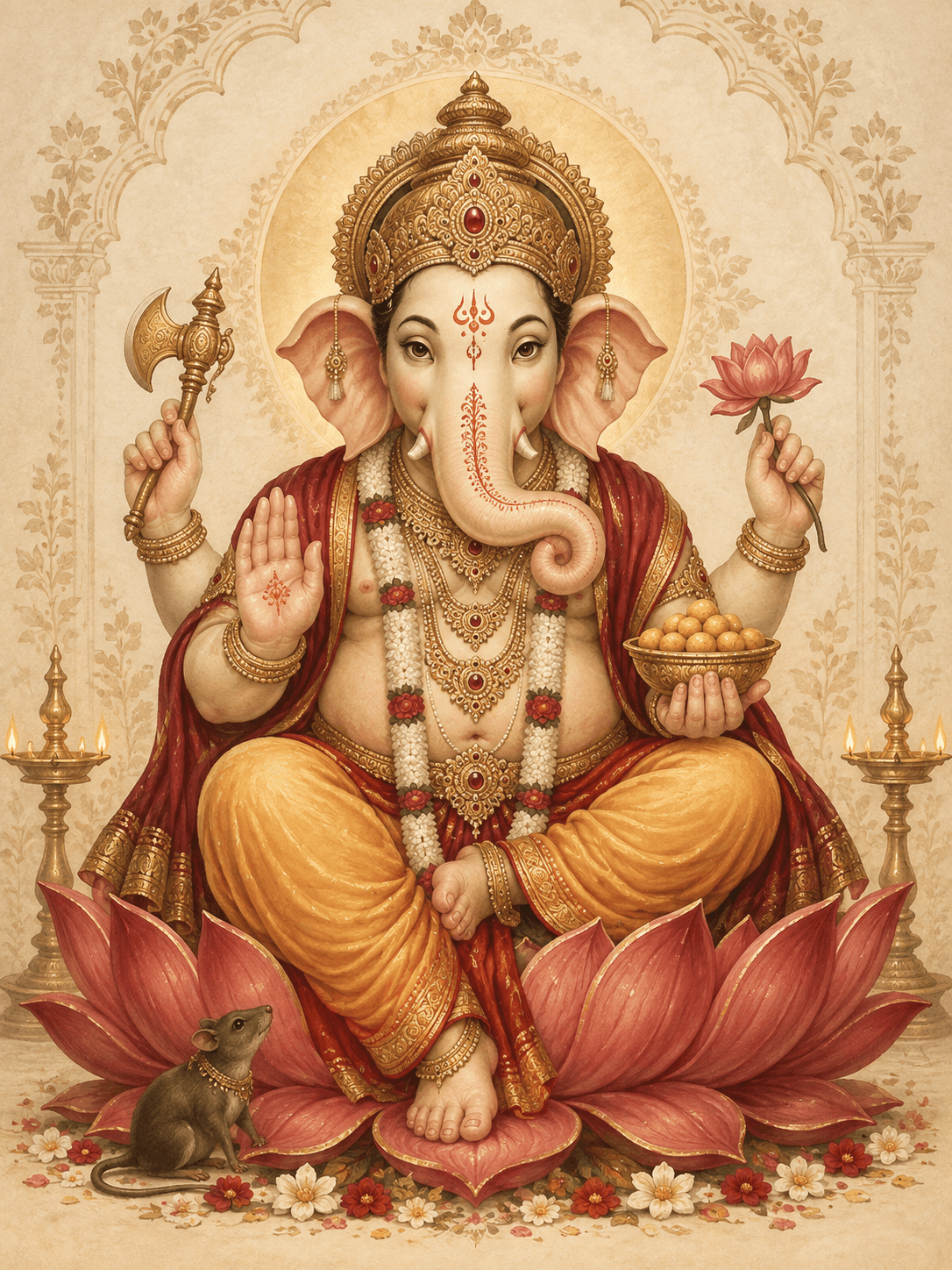
Why Chant Ganesh Mantras?
In Hindu devotional practice, Lord Ganesha is honoured as a guide at the beginning of a new undertaking. Devotees offer prayers seeking wisdom and help in overcoming obstacles.
Chanting can also provide a deliberate pause before you begin your work. Reading the meaning helps turn repetition into a thoughtful expression of devotion.
You may choose to chant before studying, beginning a project or starting your morning.
Prayer 01
1. Om Gam Ganapataye Namaha
A short prayer of salutation to Lord Ganesha
Sanskrit
ॐ गं गणपतये नमः॥
English Transliteration
Om Gam Ganapataye Namaha.
Meaning
“I offer my salutations to Lord Ganapati.”
“Gam” is a sacred seed syllable associated with Ganesha. “Ganapataye” addresses Ganapati, while “Namaha” expresses reverence or bowing.
Devotional Focus
Use this prayer to begin with humility and a clear intention.
How to Practise
Repeat the mantra slowly, allowing each repetition to finish naturally. You can begin with 11 repetitions as a simple routine, without treating the number as a requirement.
Pronunciation note: Roman spelling is an aid to learning. The ending of “Gam” has a nasal quality, and “Namaha” represents “Namaḥ.” Listening to a knowledgeable teacher can help refine the sounds.
Prayer 02
2. Vakratunda Mahakaya
An invocation before beginning an undertaking
Sanskrit
वक्रतुण्ड महाकाय सूर्यकोटिसमप्रभ। निर्विघ्नं कुरु मे देव सर्वकार्येषु सर्वदा॥
English Transliteration
Vakratunda Mahakaya Surya Koti Samaprabha Nirvighnam Kuru Me Deva Sarva Karyeshu Sarvada.
Meaning
“O Lord with a curved trunk and a great form, radiant like millions of suns, please make my undertakings free from obstacles, always.”
Devotional Focus
This prayer asks for support as you begin. It can accompany a personal commitment to prepare well, act thoughtfully and persevere through difficulties.
How to Practise
Read the verse once slowly before starting your activity. If you are learning it, practise one line at a time before reciting the complete prayer.
Prayer 03
3. Ganesh Gayatri Mantra
A prayer for illumination and guidance
Sanskrit
ॐ एकदन्ताय विद्महे वक्रतुण्डाय धीमहि। तन्नो दन्तिः प्रचोदयात्॥
English Transliteration
Om Ekadantaya Vidmahe Vakratundaya Dhimahi Tanno Dantih Prachodayat.
Meaning
“May we know the One-Tusked Lord; may we meditate upon the Lord with the curved trunk. May that Lord inspire and guide our understanding.”
Devotional Focus
Reflect on wisdom, discernment and the intention to act with greater awareness.
How to Practise
Learn the words gradually and chant at a comfortable pace. If you follow a family tradition or teacher, use the version and pronunciation taught within that tradition.
Text note: Minor wording and pronunciation variations occur across devotional traditions.
Which Ganesh Mantra Should You Choose?
| Your intention | A prayer to begin with |
|---|---|
| Learn a short daily mantra | Om Gam Ganapataye Namaha |
| Offer a prayer before starting work | Vakratunda Mahakaya |
| Reflect on wisdom and understanding | Ganesh Gayatri Mantra |
You do not need to chant all three. Choose one you understand and feel comfortable practising.
A Simple Daily Chanting Routine
Choose a Quiet Moment
Find a few minutes when you are unlikely to be interrupted. Morning or evening can work; choose a time that suits your day.
Sit Comfortably
Sit on a chair or the floor with a relaxed, upright posture. Keep your breathing natural.
Read the Meaning
Take a moment to understand what you are saying before you begin.
Set a Simple Intention
For example:
“May I approach today’s work with patience, clarity and care.”
Chant Slowly
Use a gentle voice. If your attention wanders, return to the words without judging yourself.
Close with a Moment of Silence
Pause after the final repetition. Carry your intention into one practical action, such as beginning a task calmly or speaking more patiently.
How Many Times Should You Chant?
For a simple personal routine, you might choose:
- A few repetitions while learning the words.
- 11 repetitions for a short daily practice.
- 108 repetitions if you already follow a mala-based practice and have time.
These are practice options, not a formula for guaranteed results. For a formal observance or prescribed sadhana, follow the instructions of your teacher or tradition.
What Do You Need to Begin?
For the simple devotional routine described here, you can start with the words, their meaning and a quiet moment.
An image of Ganesha, flowers or a mala may be included according to your preference and tradition. Keep the practice comfortable and manageable.
Devotion and Everyday Action
A prayer for wisdom can accompany careful decision-making. A prayer for fewer obstacles can encourage patience when a task becomes difficult.
Let chanting support the way you approach your day. Continue taking practical steps towards your responsibilities and goals.
Spiritual experiences differ from person to person; chanting does not guarantee a particular outcome.
Need Help Understanding a Recommended Mantra?
If your Vedic Report includes a mantra recommendation, our team can help you understand the written instructions and how to include the practice in your daily routine.
For a personal astrology question, explore our written guidance services.
Clear explanations · Practical guidance · Support beyond report delivery
Frequently Asked Questions
Which Ganesh mantra is suitable for a beginner?
“Om Gam Ganapataye Namaha” is a short option. Begin by learning its meaning and repeating it slowly.
Can I chant Ganesh mantras every day?
Yes, you can include a simple devotional prayer in your daily routine. Follow your own tradition for any formal practice.
Must I chant 108 times?
No. A shorter practice is a reasonable starting point. A prescribed ritual may have specific instructions.
When should I chant?
Choose a time when you can give the practice your attention. You may also recite a short prayer before beginning an important activity.
Can I chant without a mala?
Yes. A mala can help count repetitions, but you do not need one for a short prayer.
What if I make a pronunciation mistake?
Slow down and practise the difficult words separately. Learn patiently and seek pronunciation guidance when needed.
Are a Sun sign, birth chart or astrology report required?
No. You do not need an astrology report to offer these devotional prayers.
What is the difference between the three prayers?
The short Ganapati mantra expresses salutation, Vakratunda Mahakaya asks for unobstructed undertakings, and Ganesh Gayatri seeks inspiration for understanding.
Will chanting guarantee success?
No. Chanting is a devotional practice. Preparation, effort, decisions and circumstances also shape outcomes.
How can Vedic Report help?
If a mantra is recommended in your report, we can help explain the guidance and how to follow it in everyday life.
Begin with understanding. Continue with devotion. Bring your intention into your actions.
Vedic Report Editorial