Can you marry without matching?
Yes. Kundli Milan is a traditional astrological practice, not a compulsory requirement for a valid or successful marriage.
Vedic Astrology · Marriage and Relationships
Yes. Many couples marry without Kundli matching and build loving, stable relationships. Kundli Milan can add perspective, but it is not a guarantee, legal requirement, or replacement for communication, consent, and practical understanding.
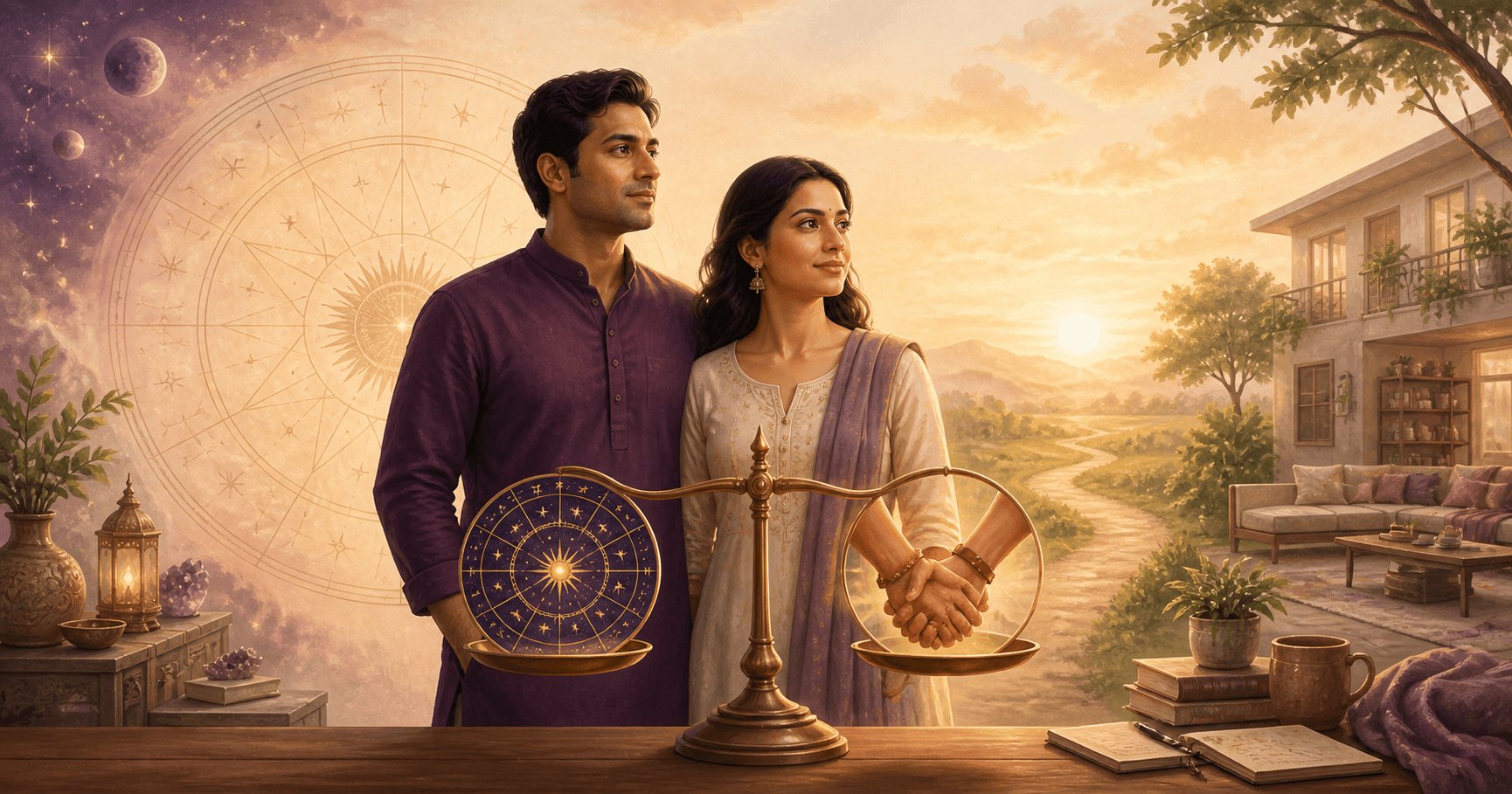
Can you marry without matching?
Yes. Kundli Milan is a traditional astrological practice, not a compulsory requirement for a valid or successful marriage.
What can Kundli Milan add?
It may highlight compatibility patterns, temperament differences, important Doshas, and planetary periods that deserve awareness.
What matters beyond astrology?
Mutual respect, consent, trust, communication, shared values, and practical readiness remain essential.
Key takeaway
Marrying without Kundli matching does not automatically cause an unhappy marriage. Kundli Milan can provide additional insight, but a relationship ultimately depends on the couple's choices, communication, maturity, and circumstances.
Kundli Milan, also called Kundali matching or horoscope matching, compares two prospective partners' birth charts. It commonly begins with Ashtakoota Guna Milan, which awards up to 36 points.
| Koota | Area studied | Points |
|---|---|---|
| Varna | Values and spiritual temperament | 1 |
| Vashya | Attraction and mutual influence | 2 |
| Tara | Birth-star harmony | 3 |
| Yoni | Instinctive and physical compatibility | 4 |
| Graha Maitri | Mental compatibility and friendship | 5 |
| Gana | Nature and temperament | 6 |
| Bhakoota | Emotional and family-related harmony | 7 |
| Nadi | Constitution and traditional health considerations | 8 |
| Total | 36 |
A detailed Marriage Matching analysis should go beyond this numerical score and examine both complete birth charts.
No. It is a cultural and astrological tradition followed by many families, with importance varying by belief, region, and custom. Some couples use it to understand compatibility, identify differences, address family concerns, examine Doshas, choose timing, or receive guidance. Others decide through shared values and mutual understanding. Both choices deserve respect.
There is no predetermined outcome. Not comparing charts does not automatically lead to conflict, separation, financial problems, illness, infertility, harm to a spouse, or an unsuccessful family life.
It simply means the couple has not used one traditional assessment. Their relationship still develops through decisions, behaviour, circumstances, and mutual effort.
Gana Koota and chart factors may describe behaviour, communication, and responses to stress.
Graha Maitri studies Moon-sign lords and traditional mental friendship.
The Moon and relationship houses may reveal emotional needs.
Yoni Koota traditionally examines instinctive attraction and intimate compatibility.
The second, fourth, seventh, and eighth houses may inform adjustment patterns.
Dashas and transits may identify more or less supportive periods.
Manglik, Nadi, Bhakoota, and other combinations require strength and cancellation analysis.
No. A score above 18 may coexist with challenged seventh houses, difficult Navamsa placements, contrasting Dashas, strong Mars or Saturn influences, or communication problems. A score below 18 may coexist with strong marriage houses, friendly Moon-sign lords, favourable Venus and Jupiter, compatible Navamsas, Dosha cancellations, and strong real-life understanding.
Closer analysis
Traditionally acceptable
Traditionally supportive
High numerical match
These are broad guidelines. A perfect score is not a guarantee, and a low score is not an automatic rejection.
The primary house of marriage and long-term partnership. Its sign, occupants, lord, aspects, and links with other relationship houses all matter.
An important divisional chart for marriage development, relationship maturity, and the deeper strength of marriage-related planets.
Love, attraction, affection, harmony, and relationship enjoyment. Its strength should be examined in both charts.
Wisdom, values, growth, respect, and the ability to sustain a meaningful partnership.
Emotions, comfort, sensitivity, and the way a person processes experiences.
Energy, assertion, passion, conflict, and Manglik considerations; it should be interpreted carefully rather than through fear.
The periods when marriage themes may become active and the experiences each partner may be navigating.
An unfavourable result should lead to deeper analysis—not panic. Ask which Kootas scored low, whether concern rests only on the total, whether Manglik Dosha or cancellations exist, what the seventh houses and Navamsas show, whether Moon-sign lords are friendly, which Dashas are active, and whether the interpretation reflects the real relationship.
A clear report explains both supportive and challenging indicators instead of labelling a marriage simply “good” or “bad.”
Yes. A low score identifies possible traditional differences, not the final outcome. Honest communication, realistic expectations, emotional maturity, respectful conflict resolution, financial transparency, shared responsibility, healthy boundaries, and qualified counselling can strengthen a relationship.
Matching is optional. A couple may already understand many aspects of each other, while astrology may add perspective on long-term patterns, family adjustment, and timing. It should not erase lived experience or create fear after commitment. The useful question is whether any chart concern reflects reality and can be managed respectfully.
Both individuals must have an equal voice in the decision to marry.
Yes. It may help explain communication styles, emotional needs, repeated conflicts, family adjustment, finances, Dashas, strengths, and effort areas. It should never be used to blame one spouse.
Full analysis is harder because houses, Ascendant, and divisional charts may change. An astrologer may use the Moon sign, birth Nakshatra, name-based matching, limited Ashtakoota, or birth-time rectification, but the report should disclose its limitations.
Whether or not you use Kundli Milan, discuss these practical areas:
Not every low score or Dosha needs a remedy. Recommendations should use both charts, connect clearly to the concern, respect beliefs, be reasonable in time and cost, avoid fear, and never guarantee outcomes.
Avoid anyone claiming an expensive ritual is the only way to prevent illness, death, separation, or another frightening outcome.
| May help with | Cannot guarantee |
|---|---|
| Exploring traditional compatibility patterns | A happy or permanent marriage |
| Identifying differences in temperament | That conflicts will never occur |
| Examining marriage-related planetary factors | A spouse's exact future behaviour |
| Recognising areas requiring communication | Protection from every life difficulty |
| Understanding relevant Dasha periods | Pregnancy, wealth, or health outcomes |
| Suggesting chart-specific remedies | Results from a ritual or gemstone |
| Supporting a more informed discussion | Replacing consent and personal judgment |
A balanced way to use Kundli Milan
Use matching to explain observations, present strengths and challenges, recognise cancellations, offer practical guidance, and respect the couple's decision. Avoid guarantees, fear, and labels that call someone unlucky.
The best question is not only “Do our Kundlis match?” but “What can we understand about each other, and how can we build a healthier relationship?”
Understand more than the final Guna score
The Vedic Report Marriage Matching Report examines both complete charts to explain emotional, mental, and practical compatibility, Doshas, cancellations, Navamsa patterns, and adjustment areas.
Get My Marriage Matching ReportDetailed PDF analysis · Based on both birth charts · Delivered via email or WhatsApp within 24–24–48 hours
Yes. Kundli matching is a traditional astrological practice, not a compulsory condition for a successful or legally valid marriage.
There is no predetermined negative outcome. The marriage will be shaped by the couple's communication, choices, circumstances, and mutual effort.
No, it is optional. It may provide an additional astrological perspective, but it should not override the couple's actual understanding or consent.
Yes. A low score or mismatch does not automatically predict failure. The complete charts and real-life compatibility should be considered.
Eighteen is traditionally treated as an acceptable starting score, but it is not a guarantee. Individual Kootas, Doshas, and the complete charts still require analysis.
It is the highest numerical Ashtakoota score, but it does not guarantee a conflict-free or lifelong marriage.
Yes. The reason for the low score, cancellation conditions, complete charts, and real-life relationship should be examined before deciding.
Manglik Dosha is a traditional consideration, but it should not be interpreted through frightening claims. Its strength, placement, and cancellation conditions must be studied in both charts.
They may be able to marry, depending on the exact Mars placements, cancellation rules, and other supportive factors in both charts.
It may indicate challenging relationship patterns, but it cannot establish with certainty that a couple will divorce. Personal decisions and circumstances remain important.
It is irresponsible to make such a claim solely from marriage matching or a Dosha. Fear-based predictions should be avoided.
Yes. It may help married couples understand communication, emotional patterns, and planetary periods, but it should not be used to assign blame.
A limited Moon-sign or Nakshatra comparison may still be possible, but the Ascendant, houses, and Navamsa may not be reliable without an accurate time.
Not necessarily. Remedies should be recommended only after analysing both complete charts and should never be presented as guaranteed solutions.
No. Consent, character, communication, health disclosures, finances, values, family expectations, and practical readiness should also be considered.
Vedic Report Editorial | September 2026
This article is provided for educational and general informational purposes based on traditional Vedic astrology principles. Kundli matching does not guarantee a particular marriage outcome and should not be the sole basis for a marriage decision. It does not replace medical, psychological, legal, financial, or relationship advice from qualified professionals.